AI Ads Need an Audit Trail Before ChatGPT or Claude Touches Your Campaigns
ChatGPT ads and Meta Ads AI Connectors point toward AI-assisted ad work. Here is what marketers should save before letting AI review, recommend, or change campaigns.
May 8, 2026
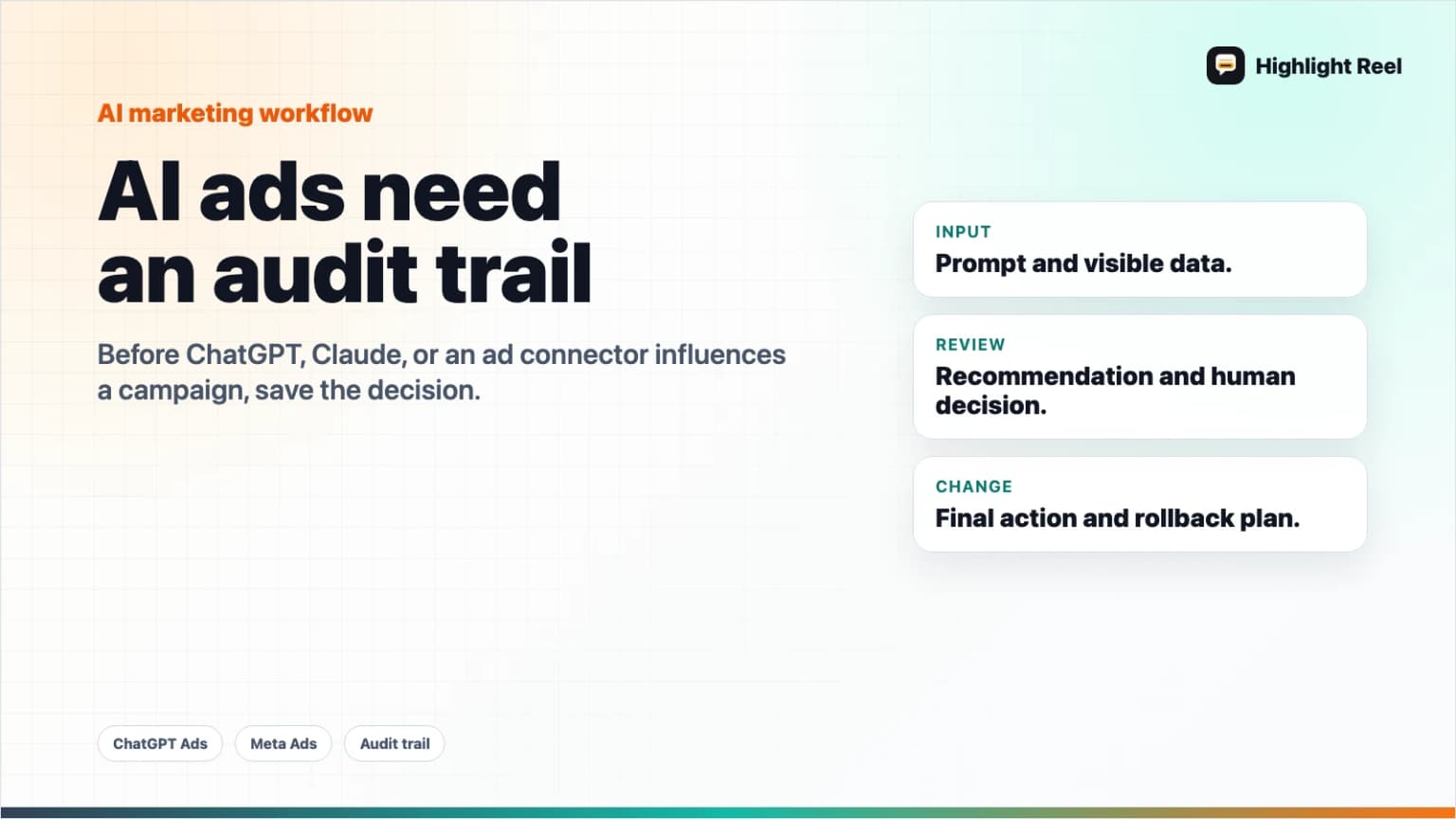
AI is moving into advertising from two directions at once.
Highlight Reel
Save the AI ad decisions worth reviewing
Turn AI campaign recommendations into a clean decision note with sources, assumptions, and human approval.
OpenAI is expanding ChatGPT ads with a beta self-serve Ads Manager, CPC bidding, and measurement tools. Meta has opened Ads AI Connectors so advertisers can use third-party AI tools in campaign workflows. Even if you do not use either feature today, the direction is clear: marketers will increasingly ask AI to analyze, recommend, draft, and eventually change campaigns.
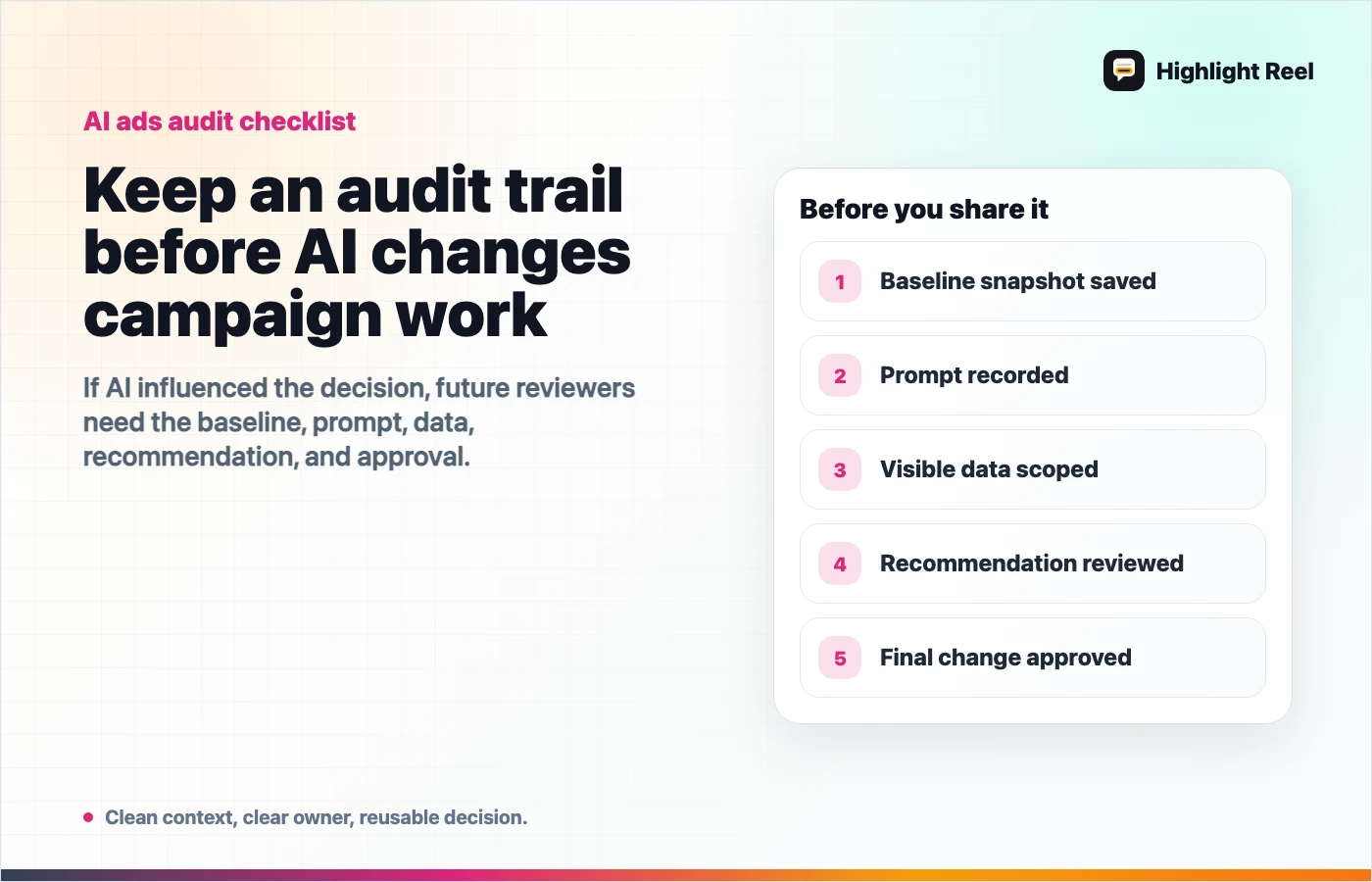
Before that happens, build an audit trail.
Quick Answer
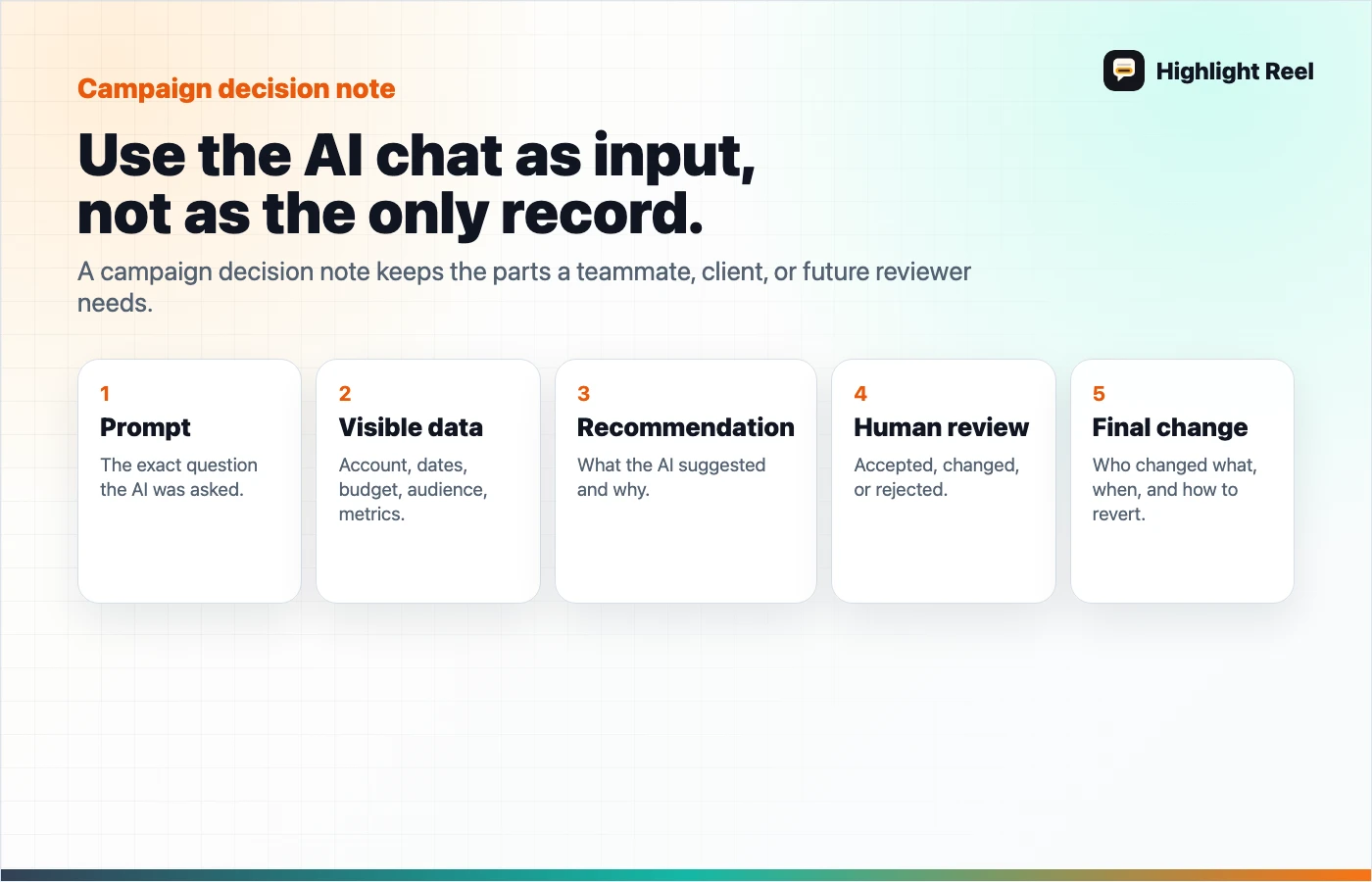
Before using ChatGPT, Claude, or another AI tool to review or manage ad campaigns, save five things:
- The original campaign state
- The AI prompt or question
- The data the AI was allowed to inspect
- The recommendation and reasoning
- The human decision and final change
If the AI can only suggest, a note may be enough. If the AI can modify budgets, audiences, creatives, catalogs, or tracking, you need a stronger review process.
Why This Is A Different Kind Of AI Workflow
Most AI writing mistakes waste time. AI ad mistakes can spend money, change attribution, weaken tracking, or confuse a team about why a campaign changed.
OpenAI says ChatGPT ads are designed around principles such as privacy and separation from ChatGPT's answers. Its Help Center says advertisers do not access conversations. That matters for user trust.
For marketers, the operational question is different:
If AI influenced this campaign decision, can we explain what happened later?That question becomes more important when AI tools can connect to ad accounts or campaign systems through connectors.
What To Save Before AI Reviews A Campaign
Use this table before asking an AI tool to audit or change ad work.
| Stage | Save this | Why it matters |
|---|---|---|
| Before AI | Campaign objective, budget, audience, creative, landing page, tracking state | You need a baseline. |
| Prompt | The exact question or instruction | The prompt frames the recommendation. |
| Data access | Which account, date range, channel, and metrics were visible | The AI can only reason from what it sees. |
| Recommendation | What the AI suggested and why | This is the decision candidate. |
| Human review | What a marketer accepted, rejected, or changed | AI advice is not the same as approval. |
| After change | Final setting, owner, timestamp, expected outcome | Future reviewers need the change log. |
The more the AI can do, the more this matters.
Read-Only AI Is Not The Same As Write-Capable AI
Separate your AI ad workflows by permission level.
| AI role | Example | Audit trail needed |
|---|---|---|
| Research assistant | Summarize ad platform docs or policy changes | Source links and summary note |
| Analyst | Review performance and identify anomalies | Data range, metrics, prompt, recommendation |
| Strategist | Suggest new campaign structure | Assumptions, alternatives, human decision |
| Drafter | Write creative variations | Prompt, brand constraints, approved copy |
| Operator | Create, edit, pause, or launch campaigns | Full change log and human approval |
Do not treat "AI helped with ads" as one category. The risk is very different when the AI moves from analysis to execution.
A Simple AI Campaign Decision Note
Use this after any AI-assisted campaign review.
# AI Campaign Decision Note

## Campaign
- Platform:
- Account:
- Campaign:
- Date range:
- Objective:

## AI Task
- Tool used:
- Prompt:
- Data visible to the AI:

## AI Recommendation
- Suggested change:
- Reason:
- Expected effect:
- Confidence:
- Caveat:

## Human Decision
- Accepted:
- Rejected:
- Modified:
- Reviewer:

## Final Change
- What changed:
- When:
- Where:
- Rollback plan:
This does not need to be bureaucratic. It just needs to be good enough that someone can answer, "Why did we change this?"
What This Means For ChatGPT Ads
ChatGPT ads are not the same thing as an AI agent changing your ad account. OpenAI's current ChatGPT ads announcement focuses on advertiser participation, beta self-serve tools, CPC bidding, and measurement.
Still, it changes how marketers should think.
People use ChatGPT while exploring categories, comparing options, and deciding what to do next. That means campaign ideas may come from AI conversations, and campaign outcomes may be interpreted through AI-assisted analysis.
For ChatGPT ads experiments, save:
- the audience or query you are trying to reach
- the ad creative and landing page version
- the hypothesis behind the ad
- measurement assumptions
- what changed after seeing results
- what not to repeat
The artifact you want is not just a screenshot of an ad. It is the reasoning trail.
What This Means For Meta Ads AI Connectors
Meta Ads AI Connectors are a stronger workflow shift because they point toward AI tools interacting with campaign systems more directly. Digiday reports that the connectors support workflows with MCP-compatible AI assistants such as ChatGPT and Claude, depending on availability and plan.
If your team tests this kind of workflow, start conservative:
- begin with reporting and diagnostics
- keep write actions disabled or tightly reviewed
- define who can approve changes
- capture before/after campaign state
- never let the AI's explanation be the only record
For agencies, this is especially important. Clients do not only care whether a campaign improved. They also care who changed what, why, and whether the change was reviewed.
Where Highlight Reel Fits
Highlight Reel can turn an AI campaign conversation into a clean decision note:
- keep the useful AI recommendation
- attach the source or metric context
- remove irrelevant exploration
- show what the human accepted
- share a readable link with a teammate or client
That is more useful than sending a raw ChatGPT or Claude thread that includes every draft prompt, every dead end, and every private account detail.
FAQ
Should I let AI change ad campaigns directly?
Start with read-only analysis unless you have clear approvals, rollback plans, and permission boundaries. Write-capable workflows need a stronger audit trail.
Do ChatGPT ads mean advertisers can read my chats?
OpenAI's Help Center says advertisers do not have access to conversations or chat history. This article focuses on the marketer-side workflow: how teams should record AI-assisted ad decisions.
What is the minimum audit trail for AI ad work?
Save the prompt, data scope, recommendation, human decision, final change, and rollback plan.
Is this only for paid media teams?
No. The same pattern applies to SEO, lifecycle email, landing page testing, product messaging, and any workflow where AI recommends changes that affect real users.