Longer Claude Code Sessions Need Cleaner Project Context
Claude Code limits are expanding, but longer sessions still need clean project context, saved decisions, and reusable handoff notes for Claude Code, Cursor, Codex, and ChatGPT.
May 8, 2026
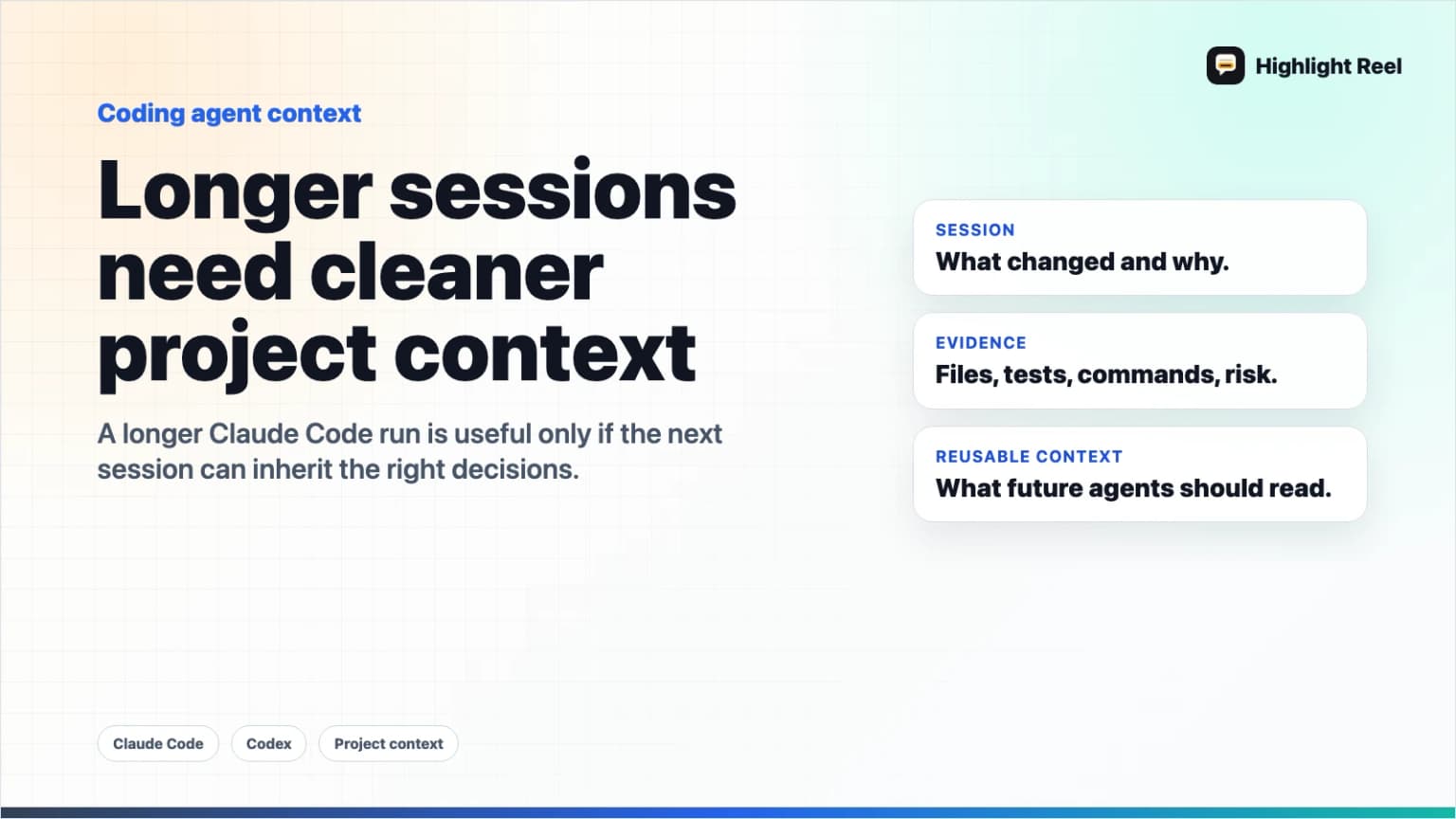
Anthropic has increased Claude Code's five-hour rate limits for Pro, Max, Team, and seat-based Enterprise plans. That is good news for people who use coding agents for real work.
Highlight Reel
Save the coding-agent context worth reusing
Turn important AI debugging sessions, architecture decisions, and handoff notes into readable Highlight Reel context.
It also makes one problem sharper: longer sessions do not automatically create better project memory.
If a Claude Code session lasts longer, it can accumulate more debugging trails, more partial decisions, more tool calls, and more assumptions. Unless you save the useful parts, the next session still starts with the same question: "What should the AI know before it helps?"
Quick Answer
Longer Claude Code sessions should produce a cleaner project context packet, not a bigger raw transcript.
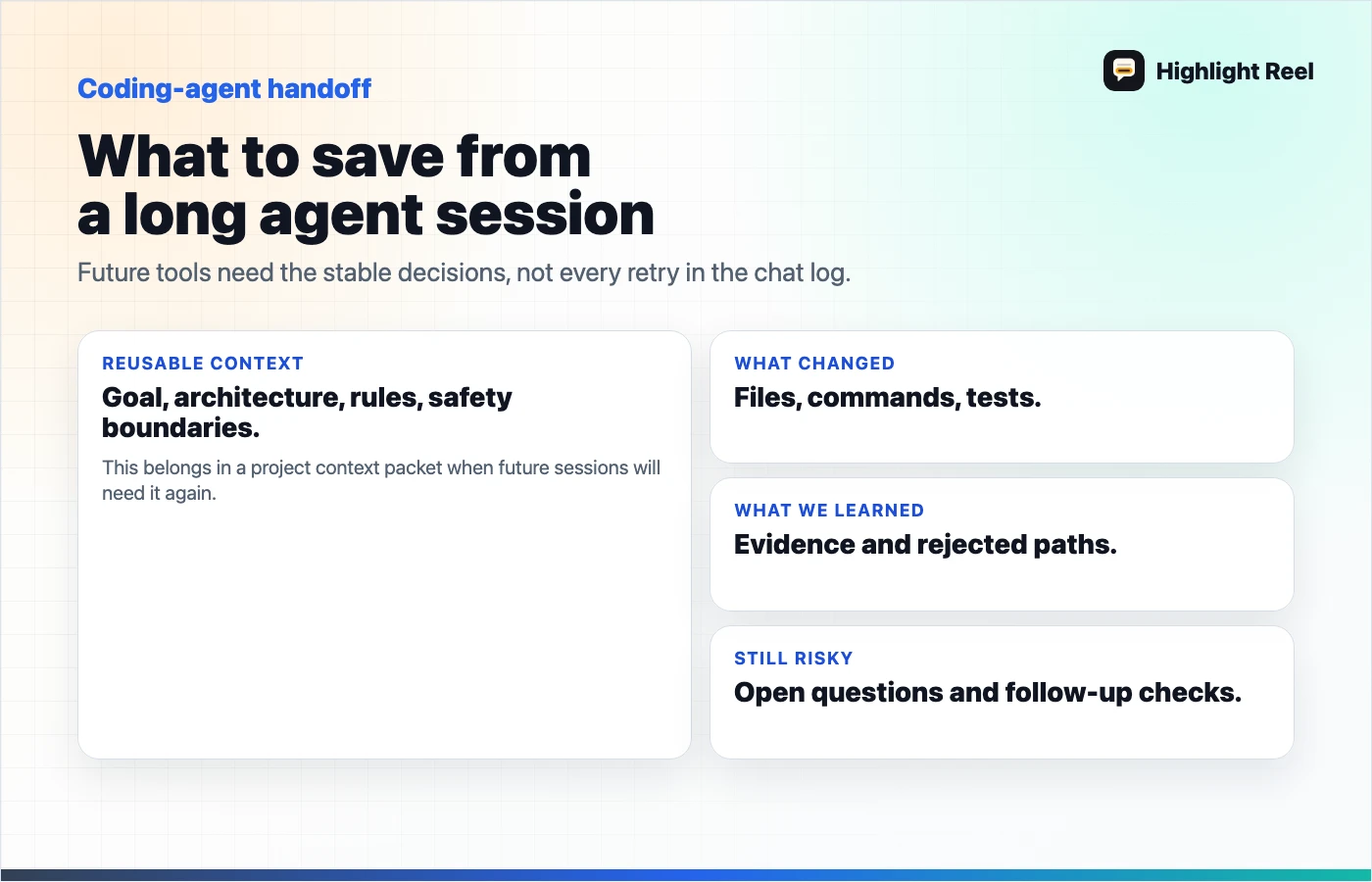
At the end of a coding-agent session, save:
- the final decision
- the files or systems touched
- the bug or task diagnosis
- the rejected paths
- the commands or checks that proved the result
- the next action for a human or future AI session
Use CLAUDE.md, Cursor rules, AGENTS.md, or an MCP-backed context source for stable instructions. Use a separate saved handoff for the session-specific learning.
Why Longer Sessions Change the Workflow
Short coding-agent sessions encourage small tasks: fix a test, inspect a file, explain a function, draft a patch.
Longer sessions encourage larger work:
- multi-file debugging
- architecture exploration
- dependency upgrades
- refactors across boundaries
- investigation plus implementation
- review plus follow-up changes
That is where raw chat history becomes unreliable as memory. The important part of a long session is not every turn. It is the trail of decisions that future work should inherit.
Claude Code's memory documentation describes project memory through files such as CLAUDE.md. Cursor uses reusable rules. Codex uses AGENTS.md as repository instructions. These files are good for stable rules, but they are not the best place to dump everything a long session discovered.
You need both:
| Context type | Where it belongs | Example |
|---|---|---|
| Stable project rules | CLAUDE.md, Cursor rules, AGENTS.md | Test commands, coding style, forbidden commands |
| Current working state | Dated worklog, task note, issue | Current branch, open blocker, deployment state |
| Session evidence | Saved transcript or Highlight Reel page | Debugging trail, source links, rejected fixes |
| Reusable decision | Context packet or architecture note | Why one approach was accepted |
What To Save From A Claude Code Session
Do not save the whole session by default. Save the parts that future work will ask for.
1. The task boundary
Write down what the session was trying to do.
Goal: reduce blog index cognitive load without changing article pages.
Scope: blog list layout, cover aspect ratio, card density.
Out of scope: public article renderer, database schema, media regeneration.
Future AI tools need boundaries more than they need every line of conversation.
2. The diagnosis
If the session debugged something, capture the real cause.
Bad:
Fixed the issue.Better:
The blog list looked overloaded because every card showed a full 16:9 cover,
three tags, a long title, excerpt, and date in a dense three-column grid.
Switching to a two-column layout reduced visual noise without hiding covers.
The diagnosis is the part that prevents the same debate from restarting later.
3. The rejected paths
Rejected paths are useful context.
Capture:
- what was considered
- why it was rejected
- whether the rejection is permanent or just for now
Example:
Rejected: one-column blog list for desktop.
Reason: easier to read, but too much vertical scrolling for 17+ articles.
Status: reconsider later if the blog becomes editorial-first rather than card-first.
4. The proof
Coding-agent work should leave evidence.
Save:
- test commands
- build commands
- screenshots or preview URLs
- before/after observations
- logs that confirmed the issue
- known residual warnings
The proof does not need to be long. It needs to be specific enough that the next session does not guess.
5. The next instruction
End with what the next agent or human should do.
Next: keep the two-column blog index. If replacing covers, use the left-headline/right-concept system and avoid tiny text in thumbnail cards.This turns a session into reusable context instead of a finished chat.
A Coding-Agent Handoff Template
Use this after a long Claude Code, Cursor, Codex, or ChatGPT coding session.
# Coding-Agent Session Handoff

Date:
Tool:
Project:

## Goal
- What the session was trying to accomplish:

## What Changed
- Files:
- Behavior:
- UI / API / data impact:

## What We Learned
- Root cause:
- Important constraints:
- Rejected paths:

## Evidence
- Tests:
- Build:
- Browser check:
- Logs:

## Still Risky
- Untested paths:
- Known warnings:
- Follow-up needed:

## Reusable Context
- Add to CLAUDE.md / AGENTS.md / Cursor rules:
- Save as project note:
- Save as Highlight Reel transcript:
When To Update CLAUDE.md, Cursor Rules, Or AGENTS.md
Do not put every session note into your permanent agent instructions.
Update stable instruction files when the learning is durable:
| Save it in rules if... | Save it as a session handoff if... |
|---|---|
| It should apply to most future tasks | It was specific to one bug or feature |
| It is a command the agent should always run | It was evidence for one investigation |
| It prevents dangerous behavior | It records a one-time rejected path |
| It describes project conventions | It describes current branch state |
| It is short and enforceable | It is narrative or exploratory |
The stable file should stay small enough that future agents actually follow it.
Where Highlight Reel Fits
Highlight Reel is useful for the evidence layer.
A long coding-agent session may include:
- the moment a root cause was found
- a useful explanation of the architecture
- a source-backed decision
- a reusable checklist
- a command sequence that proved the fix
- a conversation worth linking in a future issue
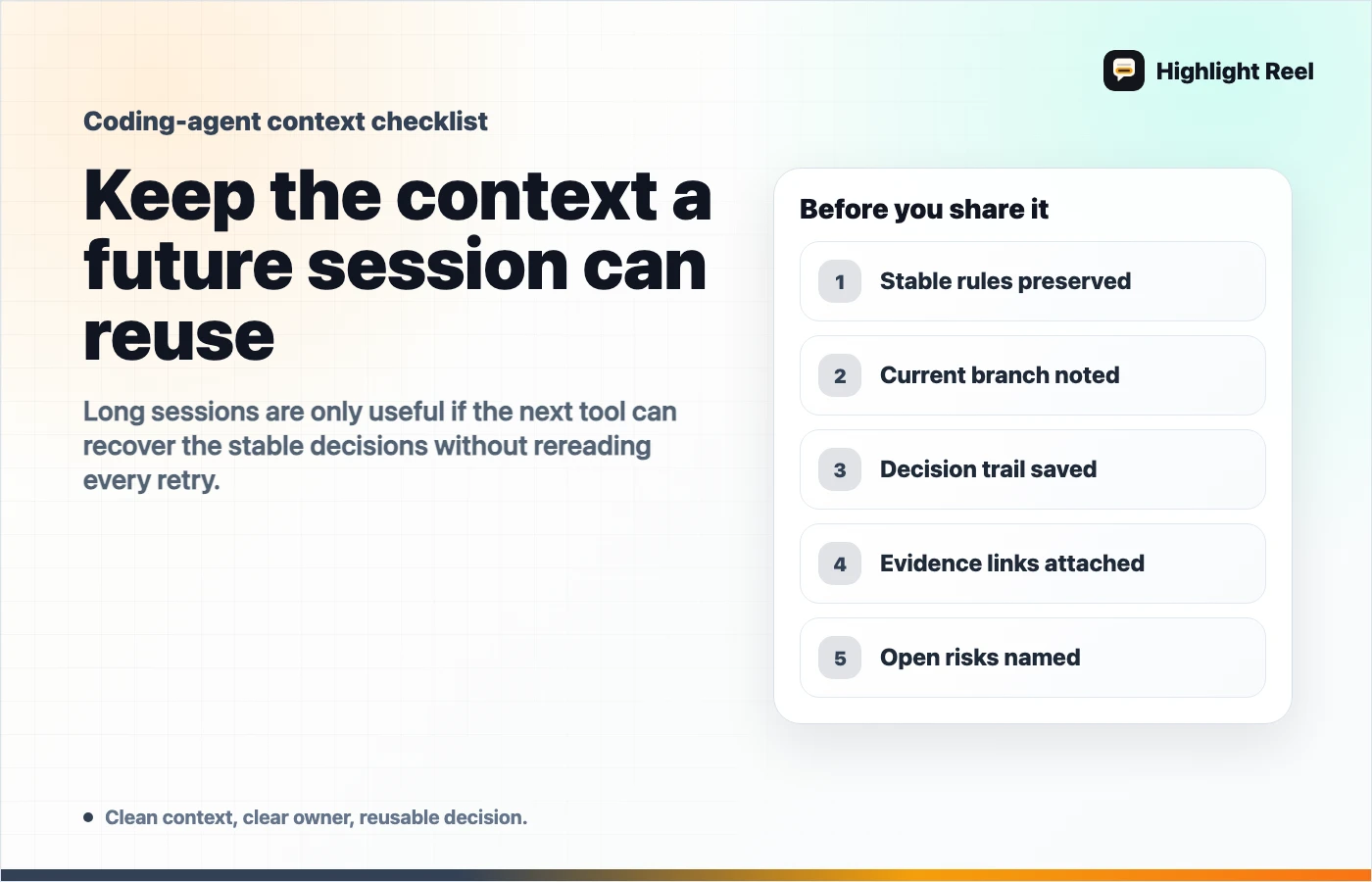
Save those useful turns as a clean transcript. Then future sessions can read the evidence without wading through every retry, typo, or temporary idea.
That is the difference between "I once solved this in a chat somewhere" and "Here is the reusable project context."
FAQ
Does a longer Claude Code limit mean I need less project memory?
No. Longer sessions help you stay in a task longer, but they do not replace durable context. If the lesson matters next week, save it outside the session.
Should I paste my entire previous coding-agent chat into the next one?
Usually not. Extract the decisions, files, proof, and next action. A clean handoff is easier for an AI tool to use than a long transcript.
What belongs in CLAUDE.md or AGENTS.md?
Put stable project instructions there: commands, code style, repository rules, privacy boundaries, and review expectations. Put dated findings and one-off investigation trails in separate notes or saved transcripts.
Can MCP help with project memory?
Yes, if the client and server support the workflow. MCP can expose saved docs, transcripts, or tools to an AI client. But you still need to decide what should be saved and what should remain private.