AI Research Summary Template With Sources, Assumptions, and Next Steps
A copyable template for sharing AI-assisted research with sources, assumptions, decisions, and next steps instead of sending a raw ChatGPT or NotebookLM thread.
May 13, 2026

AI research is easy to start and hard to hand off. A ChatGPT thread, Gemini notebook, or NotebookLM workspace can contain good source-backed work, but the next person usually needs a shorter artifact: what question was asked, what sources matter, what the answer is, what is uncertain, and what to do next.
Highlight Reel
Package AI research into a clean share link
Turn source-backed AI work into a readable page your team can review and act on.
Use this AI research source pack template when you need to share research without sending a raw AI chat or whole notebook.
Quick Answer
A useful AI research source pack has six parts:
- Research question
- Short answer
- Source table
- Assumptions and limits
- Decision or recommendation
- Next action
If any of those are missing, the reader has to redo part of your work.
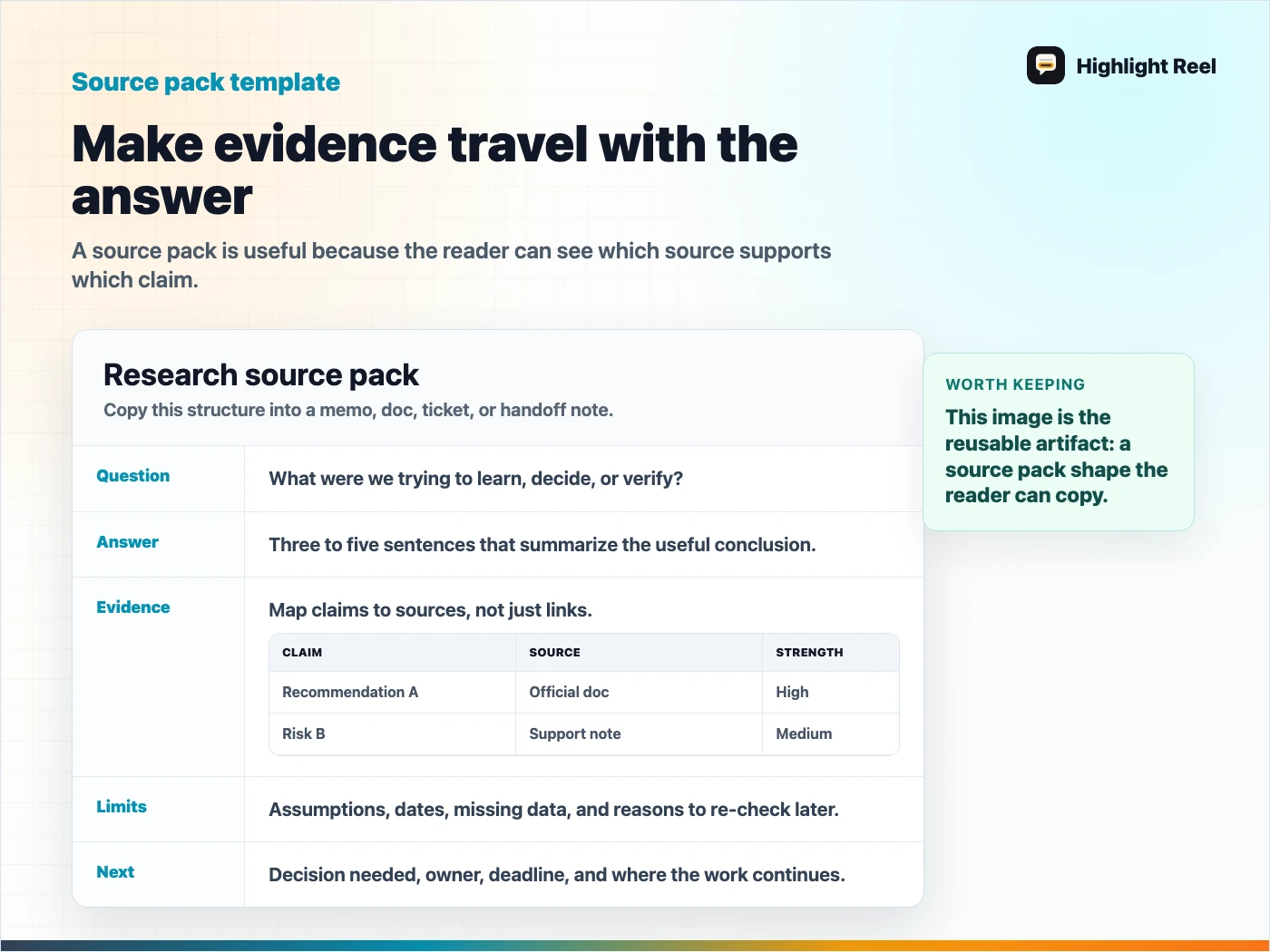
Download the AI research source pack card
Copyable Template
# AI Research Source Pack

## Research question
What were we trying to learn?

## Short answer
Give the current answer in 3-5 sentences.

## Source table
| Source | What it supports | Confidence | Notes |
| --- | --- | --- | --- |
|  |  | High / Medium / Low |  |

## Key findings
1.
2.
3.

## Assumptions and limits
- What might be outdated?
- What did the AI not verify?
- What sources disagree?
- What would change the answer?

## Decision or recommendation
What should the team do with this research?

## Next action
- Owner:
- Due:
- Smallest next step:

## Reusable context
What should be saved for future AI chats, agents, or project briefs?
Source Table Guidance
Do not just paste links. Explain what each source supports.
Weak:
- Google blog
- NotebookLM help
- Reddit thread
Better:
| Google Gemini notebook announcement | Supports the claim that Gemini notebooks sync with NotebookLM | High | Official product announcement |
| NotebookLM public notebook help | Supports public sharing behavior and chat view caveat | High | Official help page |
| Reddit discussion | Shows user concerns and language, not product truth | Low | Use as intent signal only |
This distinction matters. Official sources can support product behavior. Community threads can reveal pain points, but they should not be treated as proof of platform rules.
Confidence Labels
Use simple labels:
| Confidence | Use when... |
|---|---|
| High | The claim is supported by official docs, primary data, or a directly observed artifact |
| Medium | The claim is supported by credible secondary sources or internal evidence that may need review |
| Low | The source is a community post, anecdote, AI-generated summary, or early signal |
Do not use "High" just because the answer sounds plausible. Use it when the evidence can carry the claim.
Blank Source Row Examples
| Official doc | Supports platform behavior or product limits | High | Link to the exact help/doc page |
| Community post | Shows how users describe the problem | Low | Intent signal only, not proof |
| Internal note | Shows team decision or prior context | Medium | Remove private details before sharing |
| AI transcript | Shows reasoning path and selected turns | Medium | Include only cleaned, relevant turns |
Filled Example: NotebookLM Research Handoff
# AI Research Source Pack

## Research question
Should we send a teammate the whole NotebookLM notebook or a cleaned research handoff?

## Short answer
Use the public notebook when the teammate needs to explore the full source-backed workspace. Use a cleaned handoff when they need the answer, supporting sources, caveats, and next action. Chat View can narrow the default experience, but it should not be treated as a guarantee that underlying notebook contents are fully hidden.

## Source table
| Source | What it supports | Confidence | Notes |
| --- | --- | --- | --- |
| Google NotebookLM public notebooks help | Public sharing behavior, Google account requirement, Chat View caveat | High | Official help article |
| Google Gemini notebooks announcement | Gemini notebooks can organize chats, files, and source-backed project work | High | Official product announcement |
| Team's cleaned AI chat | Shows the actual question, tradeoffs, and decision language | Medium | Internal evidence; remove private context before sharing |

## Key findings
1. A public notebook is best when exploration matters.
2. A research handoff is better when the reader needs to act quickly.
3. Source labels and caveats should travel with the answer.

## Assumptions and limits
- Product sharing behavior may change.
- The teammate may not have the same account or access context.
- The AI-generated answer still needs source review.

## Decision or recommendation
Send a cleaned research handoff first. Include the public notebook only as an optional reference if the teammate needs deeper exploration.

## Next action
- Owner: research lead
- Due: before the team sync
- Smallest next step: convert the useful AI turns into a source-backed handoff link
When To Use This Template
Use it when AI helped with:
- market research
- competitor analysis
- technical investigation
- product planning
- policy or platform comparison
- customer-support pattern review
- SEO or keyword research
- vendor evaluation
Do not wait until the research is perfect. The source pack is valuable because it makes uncertainty visible.
How Highlight Reel Fits
Highlight Reel is useful when the research started as a long AI conversation. Instead of sending the raw thread, you can select the important turns, remove private context, and turn the result into a clean page.
That page can hold:
- selected transcript
- short answer
- source table
- assumptions
- decision
- next action
The goal is not to hide the AI process. The goal is to make it reviewable.
Copy Into Slack Or Linear
Use this when the source pack is ready:
Research handoff:
- Question:
- Short answer:
- Best source:
- Biggest caveat:
- Decision needed:
- Next action:
- Source pack:
Use a source pack when the answer depends on evidence quality. Use a project handoff when the next step matters more than source audit.
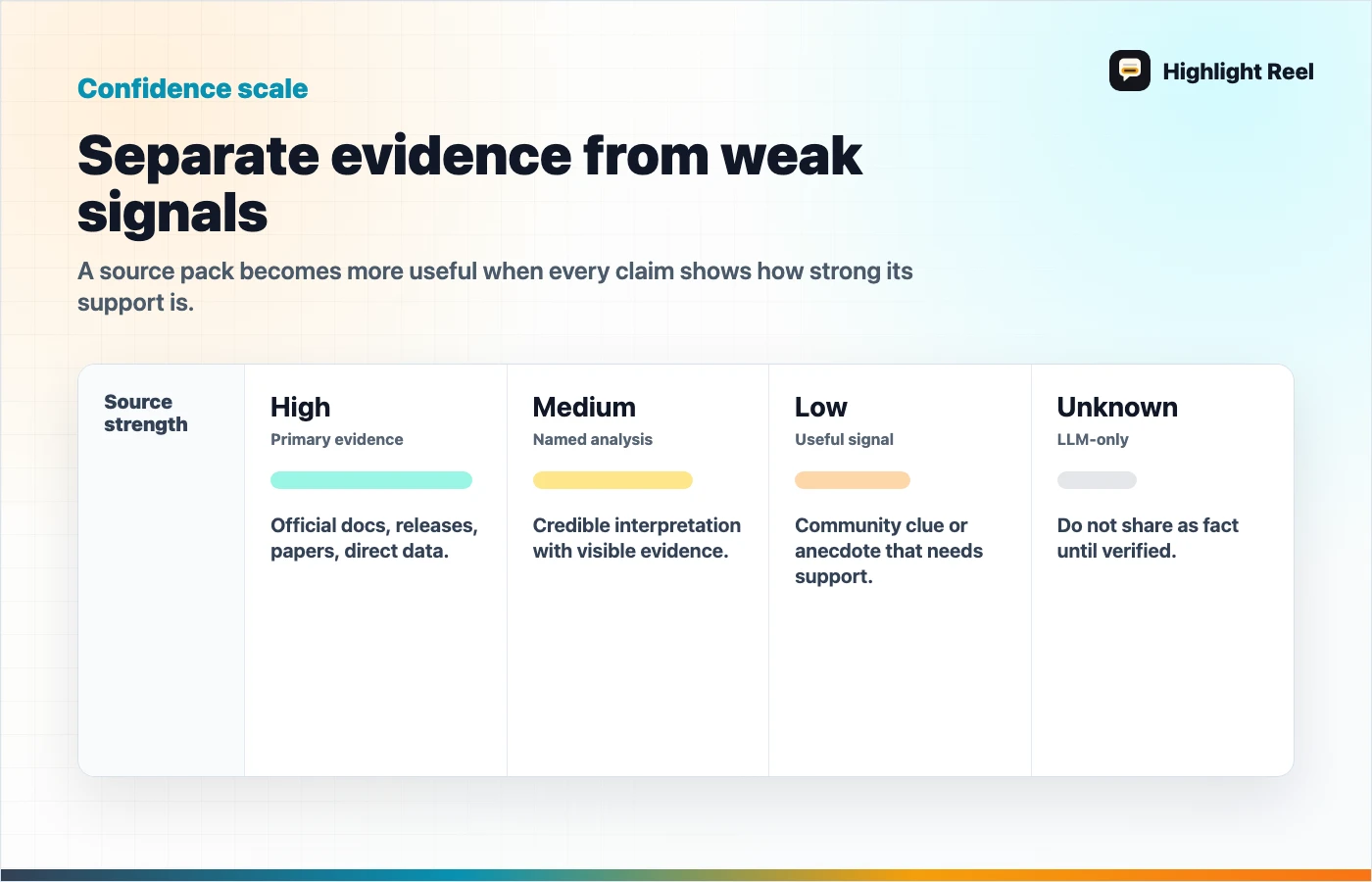
Download the AI research source confidence scale
FAQ
Is this different from a normal research brief?
Yes. A normal research brief may present polished conclusions. An AI research source pack also preserves how the conclusion was assembled, which sources support which claim, and what remains uncertain.
Should I include the full AI transcript?
Only if it helps. Often the better move is to include selected turns and a link to the cleaned transcript, not the whole raw chat.
Can this be used with NotebookLM?
Yes. Use NotebookLM or Gemini notebooks for exploration, then use the source pack when you need to share the reviewed result with a teammate.