AI Research Chat to Memo With Sources: A Realistic Example
A realistic fictional example of turning an AI research chat into a source-backed memo with evidence, caveats, and a clear recommendation.
May 13, 2026

AI research chats are often halfway between thinking and documentation. They contain source links, summaries, objections, half-rejected ideas, and a few findings that should become a memo.
Highlight Reel
Turn AI research into a source-backed memo
Preserve useful AI turns, attach sources and caveats, and share a clean research memo your team can review.
This is a realistic fictional example of turning an AI research chat into a source-backed memo. It is not a case study or customer claim. The names, task, and details are placeholders designed to show the workflow.
Use this pattern when you need an AI research memo, but the artifact in front of you is still a messy ChatGPT or Claude conversation.
Quick Answer
To turn an AI research chat into a source-backed memo:
- State the research question.
- Extract the short answer.
- Separate sources from AI interpretation.
- Label confidence for each claim.
- Capture caveats and missing evidence.
- End with a recommendation and next action.
The memo should let a teammate review the evidence without rereading the whole AI chat.
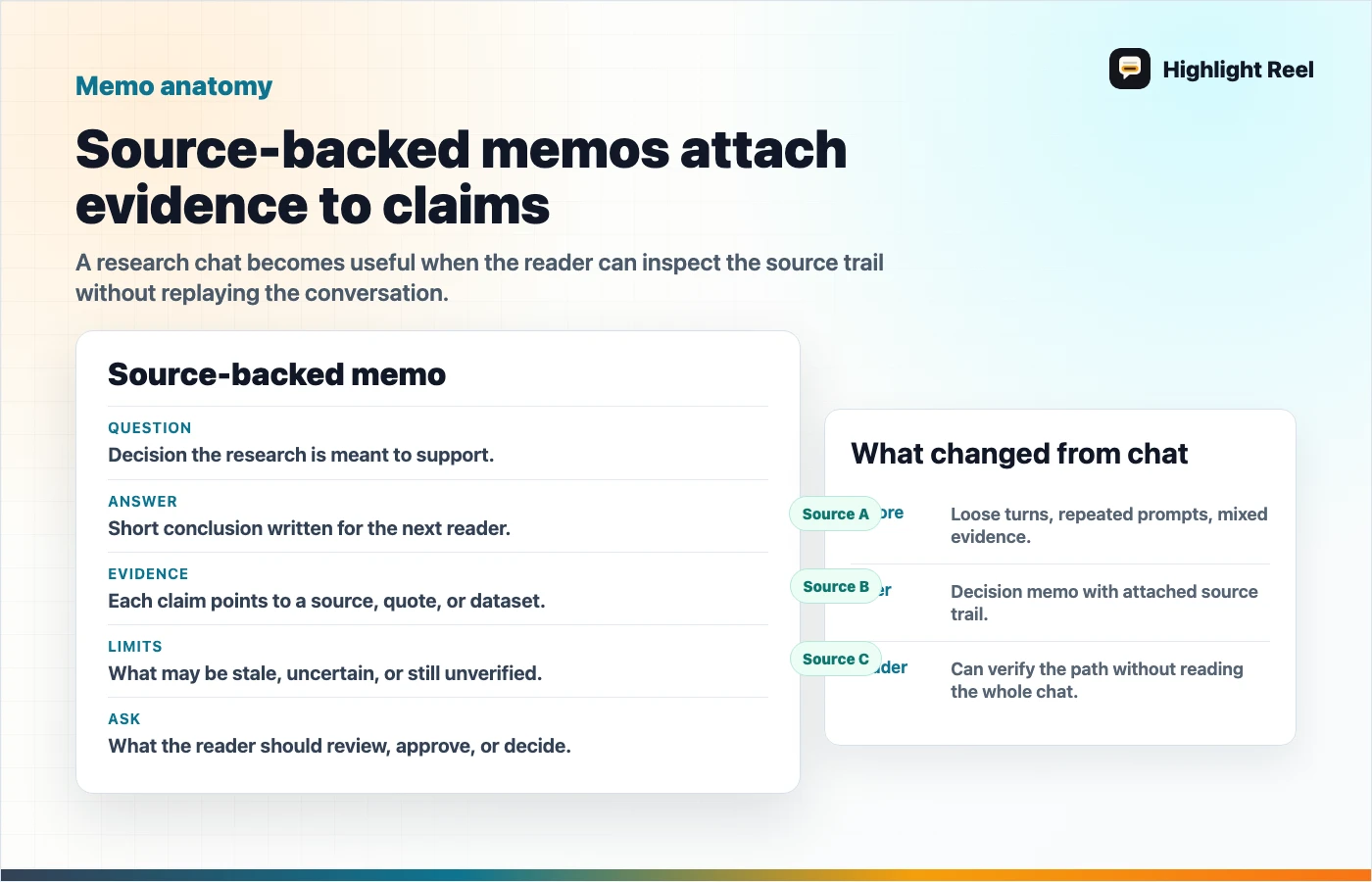
Download the source-backed memo anatomy card
Scenario: Research That Needs A Decision
Imagine an operations lead asks:
Should we use shared AI chat links or cleaned research memos when sending platform research to the product team?
The researcher opens ChatGPT and Claude, asks comparison questions, pastes official help links, and asks for a recommendation. After 45 minutes, the AI research chat has useful work, but it is not safe to send as-is.
The raw chat includes:
- official platform links
- AI summaries of those links
- unsupported guesses about team behavior
- repeated comparison tables
- a few strong caveats
- a final recommendation
The team needs a source-backed memo, not the whole conversation.
Before: AI Research Chat
Prompt:
Compare shared AI chat links, project workspaces, and cleaned research memos.

AI:
Shared links are easiest. Projects are best for collaboration. Memos are best
for decisions.

Prompt:
Use official sources only for platform behavior.

AI:
OpenAI shared links create conversation snapshots. ChatGPT Projects keep chats,
files, and instructions together. Claude Projects are self-contained
workspaces with project knowledge.

Prompt:
What should our team do?

AI:
For research handoffs, send a source-backed memo first. Include the shared link
or project only when the teammate needs to inspect the workspace.

Prompt:
Make this into a table.

AI:
...
This is useful, but the source boundaries are weak. The AI answer and the official sources are mixed together.
After: Source-Backed Memo
# Source-Backed Memo: Sharing AI Research With Product

## Research question
When should we send a shared AI chat link, a project workspace, or a cleaned
research memo?

## Short answer
Use a cleaned research memo when the teammate needs to make a decision. Include
a shared chat or project link only as supporting material when the teammate
needs to inspect the original workspace or conversation sequence.

## Source table
| Source | What it supports | Confidence | Notes |
| --- | --- | --- | --- |
| OpenAI ChatGPT shared links FAQ | Shared links are conversation snapshots and access depends on having the link | High | Official help page |
| OpenAI ChatGPT Projects help | Projects keep chats, files, and instructions together for ongoing work | High | Official help page |
| Anthropic Claude Projects help | Claude Projects are workspaces with chat histories and project knowledge | High | Official help page |
| AI research chat | Shows our framing and draft recommendation | Medium | Useful internal reasoning, not platform proof |

## Recommendation
Use a memo as the default team handoff. Add the raw AI chat link only when a
reviewer asks for the full trail.

## Caveats
- Platform behavior can change, so link to official docs.
- A project workspace is useful for ongoing research, but a memo is easier to
  review in Slack, docs, or tickets.
- The AI chat should not be treated as a source unless the specific source is
  linked and labeled.

## Next action
Create a reusable memo template and test it on the next research handoff.
The after version is shorter than the chat and stronger than a summary. It shows what supports each claim.
Why The Source Table Matters
An AI research memo fails when it hides the difference between source and synthesis.
| Memo element | Job |
|---|---|
| Research question | Keeps the memo from drifting into a general essay |
| Short answer | Gives the reader the useful conclusion first |
| Source table | Shows which claims are supported |
| Confidence label | Separates official evidence from weak signals |
| Caveats | Prevents the memo from sounding more certain than it is |
| Recommendation | Turns research into a decision |
| Next action | Makes the handoff operational |
The source table is the part that makes this a source-backed memo rather than a polished AI answer.
Template Block
# AI Research Memo

## Research question

## Short answer

## Source table
| Source | What it supports | Confidence | Notes |
| --- | --- | --- | --- |
|  |  | High / Medium / Low |  |

## Key findings
1.
2.
3.

## Caveats and open questions
- What could be outdated?
- What did we not verify?
- What did the AI infer?

## Recommendation

## Next action
- Owner:
- Destination:
- Due:
Use this template when an AI chat helped gather research but the team needs an artifact they can trust.
What To Keep From The AI Chat
Keep:
- the prompt that defined the research question
- source links and source-specific notes
- comparisons that changed the recommendation
- corrections where unsupported claims were removed
- caveats and uncertainty
- the final recommendation
Remove:
- unsupported AI guesses
- repeated tables
- prompts that only adjusted tone
- private context that does not help the reader
- source links that were not actually used
How Projects Fit
ChatGPT Projects and Claude Projects can help keep research context in one place. That is useful when the work is still ongoing or when multiple chats and files belong together.
A source-backed memo has a different job. It is the reviewed output that travels to a teammate, ticket, doc, or decision thread.
Use the project as the workspace. Use the memo as the handoff.
How Highlight Reel Fits
Highlight Reel helps when the research trail is trapped in a long AI chat. You can pull out the useful turns, attach the source table, remove private context, and share a clean memo link.
That gives the teammate the evidence trail without asking them to audit every prompt.
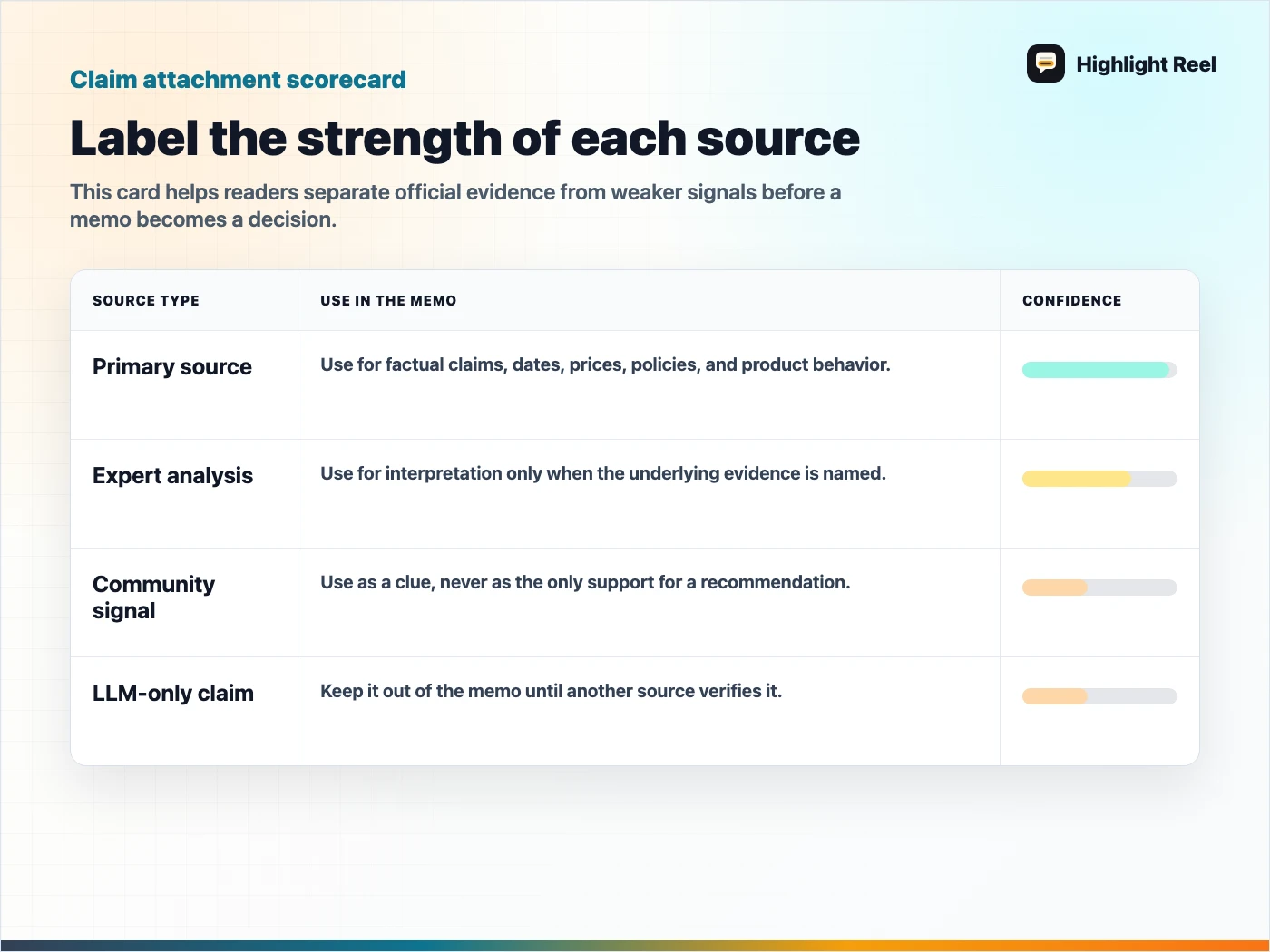
Download the AI research source confidence scale
FAQ
Is an AI research memo the same as a source pack?
They overlap. A source pack emphasizes evidence organization. A memo adds the decision, recommendation, and next action.
Should the AI chat itself be listed as a source?
Usually list it as internal reasoning or selected transcript, not as proof of platform behavior. Use official docs for platform claims.
Can I send both the memo and the shared AI chat?
Yes, when the reviewer needs the full trail. Send the memo first so the reviewer knows what to look for.